
Performing Umrah
Tawaf Explained: How to Circle the Kaaba Step by Step
Tawaf is seven counter-clockwise circuits around the Kaaba, starting and ending at the Black Stone. Here is how to perform it, which floor to choose, how to keep count and what to do if prayer starts or your wudu breaks.
General guidance, not a religious ruling. Practice can differ between schools of thought; for your own circumstances, consult a qualified scholar.
Quick answers
- How many circuits are in Tawaf?
- Seven. Each circuit starts and ends in line with the Black Stone corner, walking counter-clockwise with the Kaaba on your left.
- Do I need wudu for Tawaf?
- The majority of scholars hold that wudu is a condition of Tawaf, based in part on the narration that Tawaf is like prayer. Hanafi scholars hold that it is obligatory but not a condition of validity.
- Do I have to touch the Black Stone?
- No. Touching or kissing it is a sunnah only when possible without harming anyone. In crowds, face it, raise your right hand toward it and say “Bismillah, Allahu Akbar”.
- How long does Tawaf take?
- Often 30 to 60 minutes on the ground floor, depending on crowds, and longer on the upper floors because each circuit is much longer.
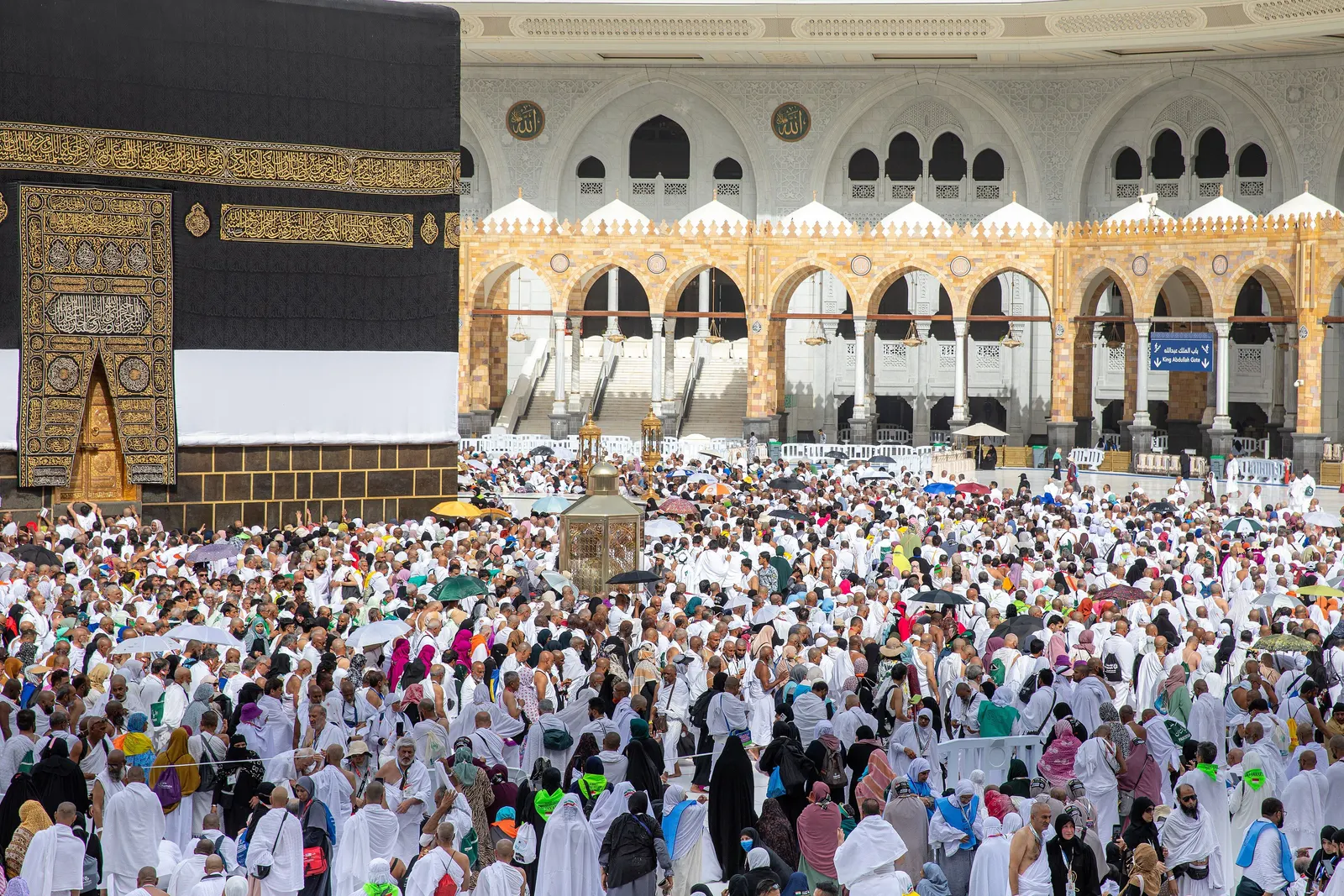
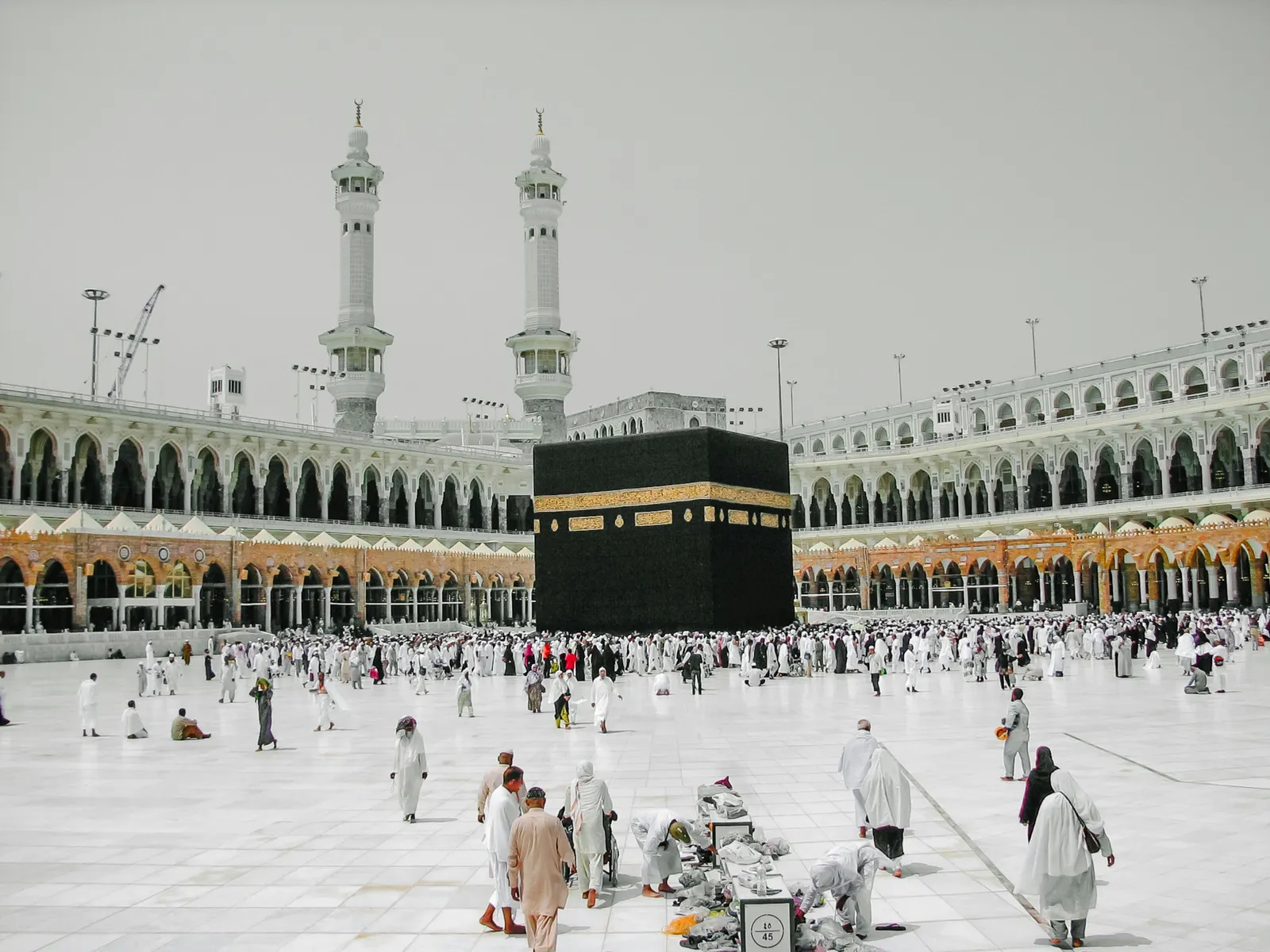
Tawaf is the first rite you perform on reaching Masjid al-Haram for Umrah: seven circuits around the Kaaba, counter-clockwise, starting and ending in line with the Black Stone. Allah says, “and let them circle the Ancient House” (22:29). For many pilgrims it is the moment they have waited years for, and knowing the steps in advance lets you give it your full attention. For where Tawaf fits in the whole sequence, see How to perform Umrah.
Before you start
- Wudu: the majority of scholars treat purity from minor and major impurity as a condition of Tawaf, partly on the narration that Tawaf is like prayer except that speaking is permitted (Jami‘ at-Tirmidhi 960). Hanafi scholars hold it obligatory but not a condition of validity.
- Intention: intend Tawaf for your Umrah in your heart. No spoken formula is required.
- Idtiba (men): wear the upper sheet under the right arm and over the left shoulder, leaving the right shoulder bare, for this Tawaf only.
- Shoes: carry them in a bag; shoe racks fill and gates are easy to confuse.
- Talbiyah: stop reciting it as you begin Tawaf.
How to perform Tawaf, step by step
- Find the start line. The Black Stone is set in the eastern corner of the Kaaba. Its line is marked by green lights on the surrounding walls and galleries.
- Greet the Black Stone (istilam). Face it, raise your right hand toward it and say “Bismillah, Allahu Akbar”. ‘Umar kissed it while affirming that it is a stone that neither harms nor benefits, and that he kissed it only because he saw the Prophet ﷺ do so (Sahih al-Bukhari 1597). Touching or kissing it is a sunnah only if you can reach it without pushing anyone; the Prophet ﷺ also gestured to the corner from a distance (Sahih al-Bukhari 1612).
- Walk counter-clockwise with the Kaaba on your left. Stay outside the low semicircular wall of the Hijr (Hatim), because the majority view is that it is part of the Kaaba and a circuit through it does not count.
- Ramal (men). In the first three circuits, men walk briskly with short steps if the crowd allows (Sahih al-Bukhari 1602), then walk normally for the last four. Women walk normally throughout.
- Make dua and remember Allah in any language. No fixed words are narrated for each circuit, so printed booklets are optional.
- At the Yemeni Corner, the corner before the Black Stone, touch it with the right hand if you can easily reach it. Many scholars say not to gesture toward it if you cannot.
- Between the Yemeni Corner and the Black Stone, recite “Rabbana atina fid-dunya hasanah, wa fil-akhirati hasanah, wa qina ‘adhaban-nar” (Sunan Abi Dawud 1892).
- Complete the circuit at the Black Stone line, greet it again and begin the next. After the seventh, stop and cover your right shoulder.
The path of one circuit
| Point on the circuit | What to do |
|---|---|
| Black Stone corner (start) | Istilam: raise the right hand, say “Bismillah, Allahu Akbar” |
| Iraqi corner and the door side | Walk on; make dua |
| Hijr Ismail (curved low wall) | Pass outside it, not through it |
| Shami corner | Walk on; make dua |
| Yemeni Corner | Touch it if easily reachable |
| Yemeni Corner to Black Stone | “Rabbana atina…” |
Two units of prayer and Zamzam
After Tawaf, pray two short units behind Maqam Ibrahim if you can do so without difficulty: “take the Station of Ibrahim as a place of prayer” (2:125). In crowds, pray anywhere in the mosque; stewards often keep the area behind the Maqam moving. Jabir’s account mentions Surah al-Kafirun and Surah al-Ikhlas (Sahih Muslim 1218). Then drink Zamzam and make dua before heading to Safa for Sa’i.
Choosing a level
| Level | Circuit length | Good for | Keep in mind |
|---|---|---|---|
| Ground floor (mataf courtyard) | Shortest | Pilgrims who are fit and want to be near the Kaaba | Densest crowds; access is sometimes limited to pilgrims in Ihram at busy times |
| First floor | Longer | Families, older pilgrims, a calmer pace | Partly indoors; follow the green lights for the start line |
| Upper floor or roof | Longest | Wheelchair users and electric carts on designated routes | Hot in the daytime; allow much more time |
Access to each level changes with crowds and construction, so follow signs and stewards on the day.
Tawaf in a wheelchair or electric cart
Pilgrims who cannot walk the circuits may perform Tawaf carried or seated. The Prophet ﷺ performed Tawaf mounted (Sahih al-Bukhari 1612) and told Umm Salamah, who was unwell, to perform it riding behind the people (Sahih al-Bukhari 1619). According to the Pilgrim Experience Program, manual carts are deployed across the mosque and electric carts can be booked electronically at peak times. Availability is not guaranteed, so plan ahead with our accessibility guide.
Keeping count and other common questions
If you lose count
Build on the number you are sure of, which in practice means the lower number. Counter rings or a phone tally help, and families can agree that one person keeps count.
If your wudu breaks
Scholars differ. Many say to leave, renew wudu and restart; others allow you to continue from where you stopped. Ask a scholar or your guide, and plan to use the restrooms before you start.
If the prayer begins
Join the prayer where you are, then continue from the point where you stopped.
Women and menstruation
In mainstream practice a woman who is menstruating does not perform Tawaf until she is pure (Sahih al-Bukhari 305). Scholars discuss what to do when travel dates leave no time to wait; please consult a scholar. See our guide for women.
This guide describes mainstream practice with references to the Qur’an, hadith collections and official Saudi guidance. Details differ between schools of thought, and it is not a religious ruling. For questions about your own situation, please ask a qualified scholar you trust.
A hotel within an easy walk makes it possible to rest and return for a calmer Tawaf. Compare options in our Makkah and Madinah hotels, then get your personalized quote. Families can start with family packages.
Frequently asked questions
What happens if the call to prayer is made during Tawaf?
Join the congregational prayer where you are, then continue Tawaf from the point where you stopped. This is the common practice, and many scholars hold that you do not restart the circuit, though some say to restart it. Follow the stewards’ directions during prayer.
Can I take a break during Tawaf?
A short break, for example to rest, drink water or rejoin your family, is widely accepted. Scholars differ on how long a break can be before the circuits are no longer continuous. If you need a long rest, ask a scholar or a qualified guide.
Is Tawaf on the upper floors valid?
Yes. Tawaf on the upper levels of Masjid al-Haram is widely accepted, and it is often the practical choice for older pilgrims, families and wheelchair users. The circuits are much longer, so allow more time.
Can children perform Tawaf?
Yes. Parents commonly carry or hold young children through the circuits. See Umrah with children for practical tips and the points to ask a scholar about.
Do I keep reciting the Talbiyah during Tawaf?
No. The Ministry’s Ihram guide notes that a pilgrim performing Umrah stops the Talbiyah on reaching the Kaaba or beginning Tawaf.
Is there a farewell Tawaf after Umrah?
The farewell Tawaf is a rite of Hajj. For pilgrims leaving Makkah after Umrah, scholars differ on whether it is required or recommended, and many pilgrims perform a voluntary Tawaf before they leave. Ask a scholar about your own case.
What are the main stages of Umrah?
In mainstream practice, Umrah has four parts: entering Ihram with the intention at or before the miqat, Tawaf (seven circuits around the Kaaba), Sa’i (seven walks between Safa and Marwah), and shaving or trimming the hair, after which the restrictions of Ihram end. Our step-by-step guide explains each part. Schools of thought differ on some details, so please ask a qualified scholar about your own situation.
What is Tawaf?
Tawaf is walking seven times around the Kaaba counterclockwise, starting and ending in line with the Black Stone, while making supplication and remembrance. You can perform it on the ground level near the Kaaba or on the upper floors, which are longer but less crowded and include routes for wheelchair users. Our guide to Tawaf covers the conditions and practical tips; ask a qualified scholar about questions of ritual validity.
Sources and official references
- Qur’an 22:29 (circling the Ancient House) (opens in a new tab)
- Qur’an 2:125 (the Station of Ibrahim as a place of prayer) (opens in a new tab)
- Sahih al-Bukhari 1597: ‘Umar and the Black Stone (opens in a new tab)
- Sahih al-Bukhari 1602: ramal in the first three circuits (opens in a new tab)
- Sahih al-Bukhari 1612: Tawaf mounted, gesturing to the corner (opens in a new tab)
- Sahih al-Bukhari 1619: Umm Salamah’s Tawaf while unwell (opens in a new tab)
- Sunan Abi Dawud 1892: the supplication between the two corners (opens in a new tab)
- Jami‘ at-Tirmidhi 960: Tawaf is like prayer (opens in a new tab)
- Sahih Muslim 1218: Jabir’s description of the Prophet’s pilgrimage (opens in a new tab)
- Ministry of Hajj and Umrah: Umrah guide (English, PDF) (opens in a new tab)
- Pilgrim Experience Program: smart mobility services at the Two Holy Mosques (March 2026) (opens in a new tab)
- Ministry of Hajj and Umrah, Kingdom of Saudi Arabia (opens in a new tab)
Sources checked . Rules for visas, travel and health change. Always confirm with official sources before you travel.
Preparing for your first Umrah?
A specialist can help you plan the journey around the rites, from arrival in Makkah to your days in Madinah.
Plan My Umrah
Safa Rihla Umrah Editorial Team
Umrah travel specialists
Guides from the Safa Rihla Umrah team are written for pilgrims traveling from the United States. They combine practical travel planning with mainstream explanations of the rites, note where scholarly opinions differ, and say so when a guide is still awaiting review by a qualified reviewer. They are general information, not personal religious rulings; please consult a qualified scholar about your own circumstances.
Related guides
All guides
Performing Umrah
Sa’i Between Safa and Marwah: How to Perform It
Sa’i is seven legs between the hills of Safa and Marwah, starting at Safa and ending at Marwah, performed after Tawaf. Here is the route, what to say, the green-light section, floors and wheelchair lanes, and the questions pilgrims ask most.
5 min read
Performing Umrah
Ihram Explained: Rules and Practicalities for Men and Women
Ihram is the sacred state you enter with the intention for Umrah at or before the miqat. Here is what men and women wear, what is restricted, where the schools differ, and how to enter Ihram on a long flight from the United States.
5 min read
Performing Umrah
Planning Your Umrah Day: Timing, Rest and Crowds
Plan your Umrah day around three things: rest after the flight, the five daily prayers, and the heat. Here is a sample timeline from arrival to the final trim, with quieter times to aim for and what to carry.
5 min read
Performing Umrah
Common Umrah Preparation Mistakes (and How to Avoid Them)
The most common Umrah mistakes happen before you leave home: no plan for the miqat, Ihram packed in checked luggage, an unchecked permit, the wrong hotel for your group, and no rest after the flight. Here is a checklist to avoid each one.
5 min read
Performing Umrah
Umrah Etiquette and Preparation Tips
Good Umrah etiquette comes down to sincerity, patience and consideration for other pilgrims: settle debts and disputes before you go, keep phones and photos discreet, never push for the Black Stone, and follow mosque staff. Here is a practical guide.
5 min read